COVID-19 Kit Testing Laboratory
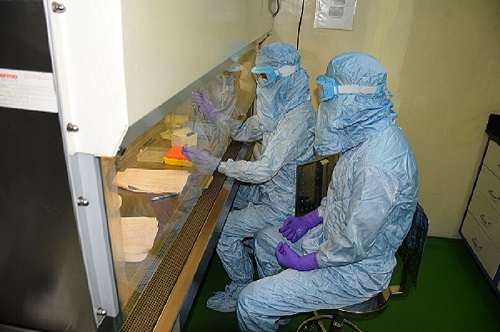
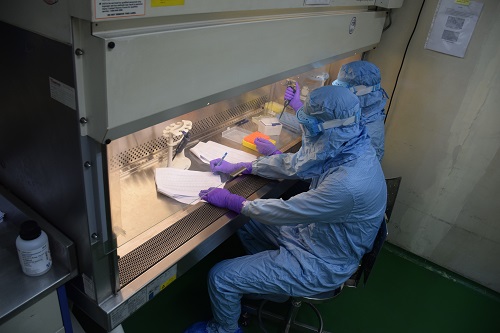
The COVID-19 Kit Testing Laboratory (CKTL) is responsible for the quality control evaluation of COVID-19 diagnostic kits, with a focus on ensuring their safety, reliability, and performance. The laboratory assesses a diverse range of in vitro diagnostic (IVD) devices, including SARS-CoV-2 RT-PCR kits, viral RNA extraction kits, viral transport media (VTM) with swabs, and COVID-19 RT-LAMP kits. These kits are submitted to the laboratory by manufacturers for regulatory testing and evaluation.
The laboratory is actively undertaking research activities in parallel with its regulatory and testing functions, thereby integrating innovation driven quality assurance. The focus is on improving efficiency, standardization, and reliability in molecular diagnostics. Among its notable innovations, the laboratory has developed a highly specific and cost-effective multiplex RT-PCR assay that accurately detects and differentiates between Omicron and Delta variants of SARS-CoV-2 (Patent application no. 202411038068). As a scalable and rapid alternative to whole genome sequencing (WGS), this assay strengthens public health preparedness, particularly in resource-limited and outbreak-prone settings, and highlights the broader utility of RT-PCR in addressing emerging viral threats. The laboratory has also advanced novel diagnostic platforms, including CRISPR-Cas-based point-of-care assays for rapid and precise detection of dengue serotypes (Patent application No. 202311008402).
These technologies significantly enhance diagnostic speed, accuracy, and affordability, making them well-suited for decentralized and low-resource healthcare environments. Additionally, such platforms are designed for simplicity and field deployment, addressing critical unmet needs in the management of infectious disease outbreaks, including those in endemic regions. The CKTL functions under a well-established Quality Management System and holds accreditation from the National Accreditation Board for Testing and Calibration Laboratories (NABL), Quality Council of India (QCI), New Delhi, in accordance with ISO/IEC 17025:2017 standards (Accreditation Certificate No. TC-7725). The laboratory is also an active participant in the External Quality Assurance Scheme (EQAS) for SARS-CoV-2 conducted by Christian Medical College (CMC), Vellore, ensuring sustained accuracy and reliability in testing outcomes.
The laboratory evaluates diagnostic kits based on key performance parameters such as sensitivity and specificity. Testing is performed using well-characterized molecular reference panels derived from oral and nasal swab samples, which are validated against primary reference materials procured from the National Institute for Biological Standards and Control (NIBSC), United Kingdom.
The CKTL receives IVD samples under established regulatory frameworks, both for batch testing under commercial import and manufacturing licenses, and also for performance evaluation under a testing license. Following evaluation, test reports are submitted to the Drugs Controller General of India (DCGI) and other concerned authorities. Under the Medical Device Rules, 2017, the laboratory operates with the support of notified Medical Device Testing Officers (MDTOs) authorized to conduct testing of molecular diagnostic kits under Form MD-38 with All India jurisdiction at NIB, Noida, as per Gazette Notification S.O. 912(E) dated February 18, 2026, preceded by Notification S.O. 5331(E) dated December 10, 2024.
In addition to its regulatory functions, the CKTL contributes significantly to capacity building and skill development. It conducts training programs under the National Skill Development and Hands-on Training Programme organized by the National Institute of Biologicals (NIB), Noida, for postgraduate students from various institutions. The laboratory also provides structured training in molecular diagnostic techniques and supervises undergraduate and postgraduate research projects, thereby supporting academic growth and professional development in the field.
Salient Recent Publications
1. Misra G*, Gupta M, Singhal R, Qaisar S, Singh P, Anvikar AR. Strategic Approach to Enhancing Diagnostic Precision: Optimizing Panel Size for HBV and HCV Viral Load Monitoring Kits. Journal of Medical Virology. 2025 Jun;97(6):e70437.
2. Singh P, Misra G*, Mishra N, Anvikar A, Potdar V. Development and validation of novel RT-PCR assay for molecular diagnostic of viral variants using SARS-CoV-2 as a case study. Methods. 2025 Aug 1;240:54-62.
3. Misra, G*, Manzoor, A, Chopra, M. et al. Genomic epidemiology of SARS-CoV-2 from Uttar Pradesh, India. Sci Rep 13, 14847 (2023).
4. Chand T, Dubey AK, Misra G*. Unraveling HPV-associated cancer complexity: From molecular insights to innovative therapies. Heliyon. 2025 Feb 15;11(3).
5. Anoop Kumar, Supriya Saini, Anup Anvikar, Neelima Mishra, Gauri Misra*, (2025). The evolving landscape of emerging virus diagnosis: Challenges and Innovations, Molecular Biotechnology
6. Kumar A, Misra G*, Mohandas S, Yadav PD. Multi-epitope vaccine design using in silico analysis of glycoprotein and nucleocapsid of NIPAH virus. PloS one. 2024 May 10;19(5):e0300507
7. Anoop K, Neeraj S, Anupkumar RA, Gauri M*. (2024) Monkeypox virus: Insights into Pathogenesis and Laboratory Testing Methods. 3 Biotech, 2024
8. Misra G*, Hora S, Ginwal S, Singh N, Anvikar A. SARS-CoV-2 Variants Impact on Key Signaling Pathways Metamorphoses into Severity. Brazilian Archives of Biology and Technology. 2023 May 22;66:e23220261
Salient International Books
1. Misra G, editor. Quality Control and Regulatory Aspects for Biologicals: Regulations and Best Practices. Taylor and Francis Group, CRC Press; 2024.
2. Arivaradarajan P, Misra G. Omics Approaches, Technologies And Applications. Springer, Singapore; 2018
Salient Book Chapters
1. Satyajeet Singh, Manika P Sharma and Gauri Misra, ‘Regulatory Bodies: European Medicines Agency (EMA) and Pharmaceutical Inspection Co-operation Scheme (PIC/S)’ in Quality Control and Regulatory Aspects for Biologicals: Regulations and Best Practices”, 2024, Ed. Gauri Misra, Taylor & Francis, CRC Press, Boco Raton.
2. Bhartendu Sharma, Priyanshi Singh, Supriya Shukla and Gauri Misra, ‘Good Manufacturing Practices in Quality Control’ in Quality Control and Regulatory Aspects for Biologicals: Regulations and Best Practices”, 2024, Ed. Gauri Misra, Taylor & Francis, CRC Press, Boco Raton.













.gif)